Explore the rich history and legacy of Nairn Championship Course, designed by giants like Old Tom Morris and James Braid. Discover the unique ‘out-and-back’ design and the role of the Moray Firth in the legacy of Nairn.
Introduction: The Moray Firth Masterpiece
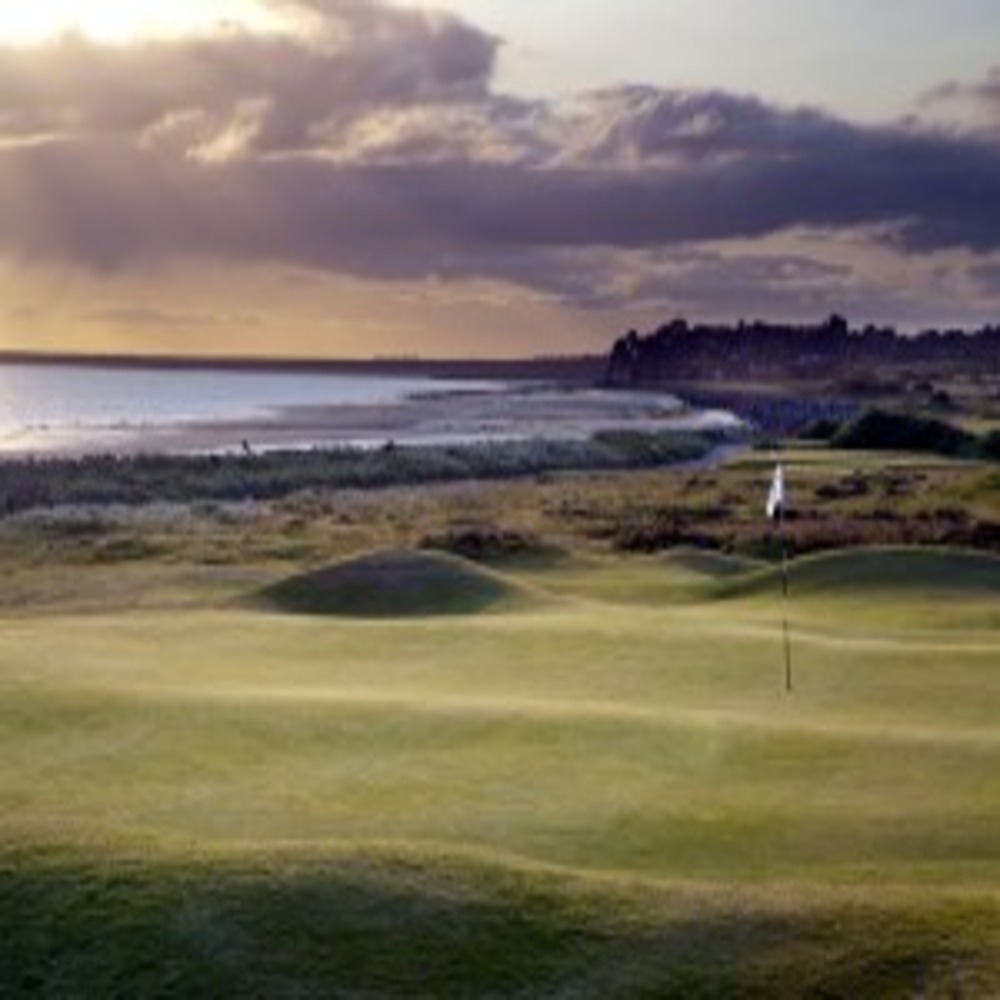
The Nairn Golf Club is not just a links course; it is a meticulous tapestry of golf history woven along the wild, breathtaking shoreline of the Moray Firth. While many Scottish courses are famous for dramatic dunes and blind shots, Nairn stands apart as a masterclass in strategic subtlety and visible threat. From every hole, the majestic view of the sea and the Black Isle beyond is a constant, shimmering reminder that you are playing golf in one of the most beautiful and exposed environments on earth.
Founded in 1887, Nairn’s Championship Course offers a less rugged, but equally demanding test than its more northerly Highland counterpart, Royal Dornoch. Its legacy is built not on a single vision, but on the accumulated genius of several legendary architects, earning it the right to host some of the most prestigious amateur championships in the world, including the Walker Cup and the Curtis Cup.
This post delves into the foundational history and architectural evolution of Nairn, exploring how the land’s original simplicity was refined by the game’s greatest designers into the celebrated, championship-ready links we play today.
The Foundational Architects: Simpson, Morris, and Braid
Unlike many courses attributed solely to a single famous name, Nairn’s identity is the result of collaboration and careful revision, establishing its pedigree as one of the 15th oldest golf clubs in the world.
Andrew Simpson: The Original Layout (1887)
The club was founded by local barrister Robert Finlay (who would later become Britain’s Lord Chancellor), recognizing the perfect linksland stretching west from the town. Andrew Simpson, the Keeper of the Green at Aberdeen, was commissioned to lay out the original design. Simpson established the course’s immediate proximity to the coastline, setting the stage for the dramatic seaside challenge that defines the opening holes.
Old Tom Morris: The First Great Revision (1890)
As the club’s reputation grew, the need for expansion and refinement became apparent. Just three years after its founding, the “Grand Old Man of Golf,” Old Tom Morris, was brought in.
- The Westward Expansion: Morris’s most significant contribution was extending the course westward over the land owned by the Earl of Cawdor. This revision opened up the ground, giving the course the more general layout and scale that we recognize today.
- Shaping the Coast: Old Tom solidified the relationship between the first seven holes and the Moray Firth, ensuring that the prevailing wind and the coastal edge dictated the opening strategy. By 1900, Nairn was already considered one of Scotland’s finest links.
James Braid: The Subtlety of Genius (1910s and 1920s)
While Morris set the frame, five-time Open Champion and renowned architect James Braid provided the defining brushstrokes. Braid’s influence on Nairn is arguably the most significant, transforming a great course into a true championship test on two separate visits.
- Refining the Greens: Braid focused on the greens and bunkers. He introduced singular subtlety to the greens, creating the fast, true, and often deceptively simple surfaces that Nairn is famous for. Their speed and undulations demand a deft touch and absolute certainty on approach.
- Strategic Bunkering: Braid’s genius lay in making the bunkers dictate strategy rather than simply punish misses. His placement forces golfers to play to specific angles, making the fairways feel narrow and demanding precision off the tee.
Further enhancements were made by Ben Sayers in the 1920s, solidifying Nairn’s reputation as a links course that is both traditional and perfectly manicured.
Architectural DNA: The Out-and-Back Links
The unique design of the Nairn Championship Course is a classic example of the traditional “out-and-back” links routing, where the front nine holes travel in one direction along the coast, and the back nine return along a similar, parallel line.
The Coastal Opening (Holes 1-7)
The first seven holes are arguably the most iconic and demanding stretch of the course, often compared to the famed oceanside holes of Pebble Beach or Royal County Down in their sheer proximity to the water.
- The Sea is the Hazard: On these holes, the Moray Firth is in play—not just visually, but strategically. A hook or a pull is instantly penalised by the coastline. The sea dictates the approach, forcing players to commit to the right side of the fairway to secure the best angle to the green.
- The Quick Start: The opening holes are viewed as the most critical scoring stretch. If the wind is down, a player must capitalize here, as the inward nine, turning away from the coast, often presents a more difficult tactical challenge.
The Inland Return (Holes 10-18)
The back nine turns slightly inland, though the sea remains visible from every single hole—a truly remarkable feature of the course.
- Strategic Complexity: The return stretch weaves through more intricate terrain, featuring heather, gorse, and clever bunkering that reward strategic positioning rather than sheer length. Holes like the 9th (Icehouse) and the closing stretch demand greater accuracy, with the firm ground and fast greens becoming the main defense.
- The Finish: The picturesque closing holes offer a chance to take in the surroundings before a challenging finish, often concluding with a spectacular par-5 on the 18th that allows for a dramatic final score.
The Championship Pedigree: Host to the World’s Best Amateurs
Nairn’s exceptional course condition and challenging, fair layout have made it a preferred venue for the R&A and USGA to test the mettle of the world’s best amateur golfers.
The Walker Cup (1999)
The club’s most famous hosting was the 1999 Walker Cup, where a Great Britain and Ireland team (featuring a young Luke Donald and Paul Casey) secured a thrilling victory over a stacked US team (featuring future major champion Matt Kuchar and Hunter Mahan).
- The Legacy of Nairn: The event cemented Nairn’s reputation on the global stage, showcasing its capacity to handle intense, world-class match play. The event’s success highlighted the subtlety of the green complexes and the strategic demands of the layout.
The Curtis Cup (2012)
Nairn was later honored to host the 2012 Curtis Cup, the prestigious women’s amateur equivalent of the Walker Cup adding to the Legacy of Nairn.
- Modern Challenge: The event proved Nairn’s adaptability, challenging the precision and short game of the women’s teams (which included future stars Charley Hull and Bronte Law).
The Amateur Championship (1994 & 2021)
The Amateur Championship, one of the biggest and most prestigious amateur events, returned to Nairn in 2021, culminating in a dramatic final won on the 38th hole. Nairn is one of only nine clubs to have hosted the Walker Cup, the Curtis Cup, the Amateur Championship, and the Women’s Amateur Championship. This status confirms its enduring quality and fairness as a supreme test of golf.
Conclusion: The Uncompromising Elegance of Nairn
The Nairn Championship Course stands as a monument to the gradual, discerning refinement of classic linksland. From Andrew Simpson’s first sketches to the profound strategic enhancements by James Braid and the modern updates by Mackenzie & Ebert in 2018, the course has always maintained its core identity: an elegant, uncompromising challenge along the Moray Firth.
Nairn is often described as possessing some of the truest and fastest greens in Scotland. Its blend of spectacular views, gorse-flanked fairways, and strategic depth makes it an essential stop for any golfer seeking the pure, genuine links experience. The enduring legacy of Nairn is its demonstration that true links golf is not defined solely by height or quirk, but by the commitment demanded by the land and the strategic finesse required to play beneath the Moray Firth wind.
Your pilgrimage to the Highlands must include this masterpiece of design. Include the Legacy of Nairn in any Scottish Golf Trip to the highlands of Scotland